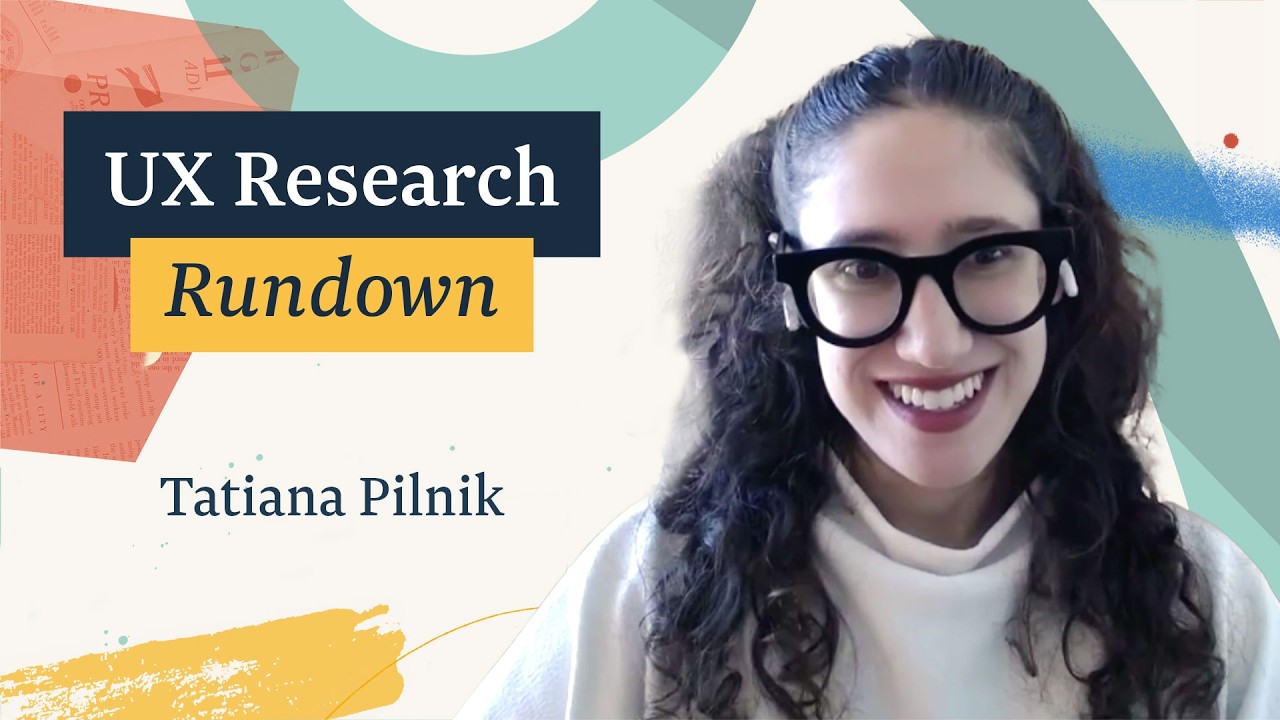
Researching AI products: trust, human in the loop and adding friction on purpose
Listen on Apple Podcasts, YouTube or your podcast app.
Lookback CEO Henrik Mattsson talks with Jessa Anderson, who manages AI/ML UX research at ServiceNow and was researching AI products before ChatGPT. They discuss how researching AI products differs from other product work, why generative AI sometimes needs more friction, not less, how to map risk with human-centered AI frameworks, what users fear about being replaced, and whether LLMs can analyze qualitative data at the scale of a survey.
Key takeaways
- Add friction where an AI mistake is costly. Generative AI can make things up and sound confident, and users often don't know it can. Slow them down and point to where an error may be, more in healthcare than for an agent handling an IT ticket.
- Ask questions early, even before you have a full opinion. AI projects bring researchers in sooner: is the data biased, which guardrails are needed, which edge cases matter.
- Map each AI use case on a two-by-two of risk and benefit. Human-centered AI handbooks and worksheets already cover transparency, explainability and contestability, so you don't need to start from scratch.
- Ask what real-world problem the product solves and whether it needs AI at all. Sometimes a business rule works fine.
- When the product team pushes back on adding checks, let them hear customers. Jessa asks users what a wrong answer would cost them, and the answer is often that they won't trust it, won't get value from it and won't use it.
Chapters
- 01:23 How Jessa Anderson got into AI research
- 03:25 Researching AI products vs using AI for research
- 05:37 How researching AI products differs from other product work
- 08:48 Pushback on adding friction to AI products
- 11:22 AI brings UX researchers to the table earlier
- 14:20 Mapping AI risk with human-centered AI frameworks
- 18:32 Will AI take users' jobs?
- 24:12 How AI will change a researcher's own work
- 30:07 Can LLMs bridge the qual and quant divide?
- 33:08 Why research AI products: the human side
About Jessa Anderson
Jessa Anderson is one of the managers of the AI/ML UX research team at ServiceNow, where she has researched AI products for almost four years, starting on what was then the company's only AI research project. She studied psychology and literature as an undergraduate, worked at a health marketing communications firm, and did a PhD in public health with an emphasis on health behavior, using mixed methods. She joined ServiceNow without AI experience after deciding academia and nonprofits weren't for her.
Transcript
Henrik Mattsson · 00:09
Hi everyone, and welcome to another episode of the UX Research Rundown, on the third season, episode two. My name is Henrik Mattsson. I am the CEO of Lookback and also the host of this show. And as you might have noticed, if you listened to the first episode of this season, we have changed our main theme for the season. We used to talk about how do you get your team along on the journey that is research. And that’s of course still relevant, but we’ve moved on to something else that’s pretty hot right now, and that’s researching AI and leveraging AI and LLMs and stuff like that for research.
So I’ve invited a bunch of interesting guests, and today I have the privilege of having with me Jessa Anderson from ServiceNow. And as per ancient podcast tradition here, we’re going to let her introduce herself in a little moment, and then we’ll get going talking about AI in research. So welcome. Thanks for being with us today.
Jessa Anderson · 01:04
Yeah, my pleasure. Thanks so much for inviting me.
Henrik Mattsson · 01:07
Awesome. And as we always do, I’m going to start by asking you for your origin story. How did you get into research? And what was your background before research, and how did you get into the AI stuff as a researcher?
How Jessa Anderson got into AI research
Jessa Anderson · 01:23
All right, I’ll try to give an abbreviated version, because it’s a pretty non-linear path here. I’ve always loved research and trying to understand the why of things. What motivates people? In my undergrad years, I studied psychology and literature, weirdly, but did a lot of research within the field of psychology, including in childhood traumatic grief and some really heavy topics. I graduated at a terrible time, in the recession in 2009, so I had to kind of get scrappy with different jobs and getting experience. So I worked at a health marketing communications firm and then traveled.
And that really spiked my interest in combining those two into a PhD in public health, with an emphasis in health behavior. And so that’s where I got really heavy into research with mixed methods. So lots of qualitative mixed with pretty intense quantitative as well, lots of modeling and things like that. But really complementing the two, which is my personal passion, using both of these methods. And so I was really doing research, I realized academia and nonprofits weren’t for me, and came into ServiceNow. So one thing you’ll hear is I did not mention any AI experience or training when I came to ServiceNow.
That’s where I learned how to leverage the skills I had and apply them in a slightly different industry and field, in UX research. And here is where I got into AI. I was put on, at that time, the only project that was being researched that was AI at ServiceNow. And so I know it feels like AI is new in some ways, with ChatGPT and all these things exploding onto the scene, but we were investigating more the classic AI. So more of the machine learning, and a lot of people’s first contact with AI through social media and things like that.
More of that type of AI.
Researching AI products vs using AI for research
Henrik Mattsson · 03:25
Right. Cool. Yeah. So on the last episode, we had Jess Holbrook, who had worked with this for like 12 years or something, all the classic AI. So he was talking about the ChatGPT moment, which was kind of like… but yeah, super interesting. First of all, let me ask you: when we’re talking about research and AI, there are two general things we might mean. One is researchers doing research on AI-integrated products, and then researchers leveraging AI and LLMs to do their job. And of course, in that field, we have all of these discussions about, will we be replaced by robots, and if not, then why, et cetera.
So have you done both of those, or where are you in those two buckets?
Jessa Anderson · 04:22
Yeah. So I am more in the research in AI, in terms of how we integrate it into products. And here at ServiceNow, my area has really focused on… There’s two sides of it, how we look at it. There’s the side of how do we help people who are not data scientists or trained AI experts in any way feel confident and empowered to implement AI into their solutions, delivering technology and these automations and helpful processes to their end users. So that might be agents, for example, or their customers or their employees, often those people.
And so that’s one side of it, which is a bit more on the technical side. And then the other side of that is the folks who are consuming the AI outputs in their day-to-day work, and how we look at building trust and gaining confidence, and making sure it’s augmenting how they work and really adding value. So that’s the area I’ve been really heavily in at ServiceNow, for almost four years now. I’m always curious about how we can use these other tools that are now coming out a lot more, but that has not been my focus.
How researching AI products differs from other product work
Henrik Mattsson · 05:37
Right. Interesting. Because I think we can expect that there’s going to be an acceleration of researchers moving into researching AI products, basically, right? But you had a bit of a head start. You were there before the ChatGPT moment. What are some of the differences you would say between the AI stuff and just regular product work, if there are any?
Jessa Anderson · 06:08
Yeah. No, that’s a fantastic question. And I do believe there are. At ServiceNow we have a whole AI/ML UX research team, which I am now one of the managers of. And our approach there is that there are some differences and ways of looking at it. And this was true with classic AI. So we really leaned into something called human-centered AI, which is tied to responsible AI as well. But really, how do we help people earn the trust in these products? And with AI, there are differences.
So, for example, we know people want to know, especially in the context of their work and life, that something came from AI and not another human. The way they need to look at it is different. As well as within generative AI. By generative AI I mean large language models, things we see like ChatGPT, where it has become a lot more conversational. So of course that transparency, making sure they know that it’s not human, is important, again, especially when we’re hearing it in the context of their work.
But in addition, this has different types of errors and imperfections that we did not see in classic AI. By that I mean it can hallucinate, right? So it can actually make things up, and present it in a way that sounds very confident, and you might not know. And so we have found that if we don’t tell people, “Hey, you need to look closely at this and make sure it’s right,” they don’t even know that it could be making something up. So this concept of imperfections and inaccuracies, and then making sure that the human can look it over, edit it, be in control of it, which often is simplified as human in the loop, is really, really critical in this space.
So it’s a slightly different perspective and way of looking at things. And because generative AI is at such an early stage right now, these errors are even more likely to happen. And so it means designing and creating experiences in a slightly counter way to what we are used to in a normal product space, potentially. We all have been told, make it seamless, easy, right? And now we’re saying, hey, let’s actually, maybe in certain contexts, add a little friction, slow people down, draw attention to where there may be an error, and where there could be a high risk of consequence if they don’t check that.
“We all have been told, make it seamless, easy, right? And now we're saying, hey, let's actually, maybe in certain contexts, add a little friction, slow people down.”
So that’s what we’re actually looking into now, which is, again, a different mindset, a different way of creating experiences, but recognizing that’s where the technology is currently.
Pushback on adding friction to AI products
Henrik Mattsson · 08:48
That’s so interesting. I mean, we’ve been doing some work of our own in the Lookback tool, where… there are so many things we can do. But what we’ve decided is basically exactly what you’re saying. The human is one thing, the machine is one thing. It has to be clear who produces what, and there should always be that kind of interaction. But what I’ve learned when we do that is that there’s the expectation of, well, just let the AI do it. Can’t it just do it?
And that’s similar to the slowing down of the experience. I totally agree with this way of working, but I think a lot of people that build product might experience that as tying the AI’s hands behind its back, et cetera. Have you had that kind of pushback? And if so, how do you handle that in a product team, for example?
Jessa Anderson · 09:38
Yeah. Fantastic point. There is sometimes pushback, because it can seem counter in a way. And so one of the things that we’ve had a lot of luck doing is going to the users and exploring, and educating the team, for example, that users don’t actually have this awareness that it could hallucinate, it could be wrong, it could be missing critical information. And it could be done in a subtle way, which maybe has worse consequences than if it’s a very blatant thing that’s made up. And showing the team the customers who have these concerns and questions and don’t know how to best use it really helps, because they get to see directly what could be.
And hearing from the customers, if we prompt them and say, “What might be a consequence for you if you do this?” Ultimately it often leads to: I won’t trust it, I won’t get value from it, and I won’t use it. And if that’s the case, then the AI is not doing what it’s supposed to do. Again, we’re not saying that it will never be able to do these things where it’s really going to help accelerate how we work, and even eventually replace certain really mundane tasks we don’t want to do.
If I could have it manage my calendar and Outlook for me, I would love that. So there’s certainly opportunity, and we know it’s in the very early stages. But really helping them recognize that it is in the early stages, and this is the critical time for us to help people build trust and feel confident and in control, and if they don’t, what that risk is. So what seems to really help is hearing it directly from who those potential users are.
AI brings UX researchers to the table earlier
Henrik Mattsson · 11:22
Right. Right. Yeah. No one wants to build technology that everyone is too afraid to use. I guess that’s a good motto. Yeah, it’s just interesting, because I was talking to someone the other day who was suggesting that with the rise of AI, technology is becoming almost more like a human. Especially with these large language models, it’s just like this irrational user that makes stuff up, and it can’t really be trusted. It kind of puts the UX research skill set at the center of actually deep tech, in a sense.
So it would actually put the researcher at the table in a totally different way than before, right? And then on the other hand, you have what you’re talking about, which is that you’re slowing down the… which has always been one of the issues that product teams take with research, right? “We don’t have time to research.” So it’s an interesting paradox. There wasn’t really a question in there, so I apologize, but what’s your reflection when you think about that?
Jessa Anderson · 12:36
Well, actually I love what you said about it bringing us to the table in a different way. And that’s something I really love about the AI space: people are recognizing that the experience matters tremendously, and again, that it comes down to trust and helping people know how it’s trustworthy and adding value to them. If they don’t trust it, they’re not going to accept it, and if they don’t see the value. So it really brings you to the table earlier. And I’ve noticed that UX researchers who don’t already have AI experience are sometimes more hesitant or cautious to speak up and ask questions.
And what I would say is, you’re getting a seat at the table a lot earlier, and you need to take advantage of that, and be okay with not having a fully formed opinion. That’s fine. But be able to speak up and ask questions, and that can be things like, is this data really biased? Because these can inform consequences too. Are there different guardrails we need to put in place? Are there edge cases we really need to think about? Certain industries, for example, may have much higher risk and higher consequences, where that trade-off is going to be more important.
“You're getting a seat at the table a lot earlier, and you need to take advantage of that, and be okay with not having a fully formed opinion.”
So if we think about healthcare, for example, the trade-off might be a lot more important there than for agents working with an IT ticket, which maybe isn’t quite as high risk. So there’s different ways to balance and think about that. And I think UX professionals can really bring that up at the table, thinking through those different risks and consequences and what that might look like for real people who have to use it or are impacted by the outcome of it.
Mapping AI risk with human-centered AI frameworks
Henrik Mattsson · 14:20
Right. Yeah. No, totally. That’s a great point. We were discussing this today with my team, because we’re doing some security stuff where a tool could use AI to provide a report for customers about this stuff. And it just felt so dangerous, because first of all, it’s a high-risk environment, it’s security. But second of all, it’s a use case where we’re asking the AI to provide the answer. There’s no human in the loop. The AI just does it, no one checks it. And then the risk of the hallucination is just unchecked.
Whereas you see some other tools where you generate just a draft, basically, and then a human is always going to finish it, which is a completely different use case. So you’ve been doing this for four years, and I think in a lot of places there must be some sort of… You have some categories and some language to talk about all of these different cases. But I think a lot of listeners are perhaps just moving into this now, and their companies are now building their first gen AI product, and they will reinvent the wheel.
So what are the different considerations? Is there a map of these buckets, like, okay, this is this kind of use case, this is this kind of use case, here it’s high risk, here it’s not high risk? Has that developed already, or is the field still too young, do you think?
Jessa Anderson · 15:49
Well, there are actually a lot of amazing tools and resources. Like I said, for people who want to get started, looking at human-centered AI is, I think, a great way to go. There’s a lot of really nice handbooks, tools that have worksheets for it. These are especially helpful if you’re going to be working with people who are more what I was describing as the consumer side of it, who are using the AI outputs in their work. And the principles that we have in the field still apply.
For example, the one that I’ve already brought up was transparency. But transparency actually includes a lot of different elements, like interpretability, traceability, data transparency, bias and fairness assessments, and a lot more. But we can often group it into transparency when we’re speaking to people. There’s feedback and contestability. There’s explainability, which has a more traditional UX understanding of it, and then the way it’s actually done in the fields of AI and ML. So there are a lot of really great resources for frameworks, as well as some helpful worksheets.
One of the simple ones that we often do, that works well, is just a simple two by two, where you have the risk and trade-off and benefit to walk through, and come up with some of the cases and map them out. And that can be a really helpful way to start really concretely thinking about what are the risks and benefits, and where would they fall in this balancing act. Because it is a bit of a balancing act, right?
Henrik Mattsson · 17:25
So the message for someone moving into this now is, just because the technology seems pretty new, there’s some reading to do. You don’t have to…
Jessa Anderson · 17:36
So many great resources. You don’t need to reinvent the wheel. Again, there might just be more heightened areas that maybe aren’t as well established and are coming out, but people are actively working on it in the field. I just don’t know how much is in the hands of UX professionals versus in the academic space. But again, all of these human-centered AI principles absolutely still apply. It’s just how much more focus we might put on them, like I was saying, because the technology is at such an early stage and the consequences can potentially be higher.
How do we think about that, and maybe emphasize that feedback and contestability part, which is more than just a thumbs up or thumbs down? Using contestability, users can provide feedback, get clarification, challenge the AI’s output. Giving that type of feedback can be really important in AI.
Will AI take users’ jobs?
Henrik Mattsson · 18:32
Right. Right. So many questions. Always so interesting. So if I understand it correctly, you’ve been doing studies with users that are trying to understand how we can build trust with the AI and stuff like that. And some of these things are about, well, can I trust it, can I try it, et cetera. But I noticed this megatrend when we’re doing research with our users who are testing our beta stuff for the AI features. There’s all of those, like, well, can I trust it? Can I use it?
But there’s also this: will this technology take my job? Well, yes. I don’t like it. Are there those kinds of things that you encounter too? Are people worried about it? Can you tell us a little bit about that?
Jessa Anderson · 19:22
Yeah, I can share my personal opinions and perspectives on it. Oh, absolutely, that is definitely a fear we’ve heard before. As well as, sometimes it’s a fear from the managers and the leads, who say, “We think our employees, who we want to use this, are going to be really fearful.” And so one thing we’ve been really leaning into to help counter that is explaining that it’s augmenting, not replacing. A big catchphrase for us is “augment, not replace,” and explaining how. So the more we’re building the human in the loop, the human checks, those human elements, into the experience, the more people are seeing that they’re really required.
And that goes into how important it is, when there’s a new product or experience, especially in their context of work, where they’re doing this for many hours a day, often. It’s not just something they can discard once and be done with, like if an app does something you don’t like. And so one thing we’ve seen, the really critical part, is helping to set realistic expectations for them on how to use it and what value it’ll bring them, and having appropriate onboarding to get them up to speed on it.
And what we’re seeing is that helps to reduce some of the fears, because they realize, oh, I’m really required in this process. It’s not going to replace me. As well, I think it falls to leadership, of course, to help message what their goals are and be clear on it. And in general, we almost never hear a goal of, “Yeah, we want to get rid of half of our workforce,” or anything like that. It’s really, how do we make them more productive, feel that they are working on things that matter to them more, and have the time to focus on those things that really require the human, and not as much what AI is good at.
Henrik Mattsson · 21:15
But would you say that when people get past those fears and they actually start using the technology, is that where they land? Or are there some real fears here? What’s the saying? Just because you’re paranoid doesn’t mean you’re not being followed.
Jessa Anderson · 21:36
Okay. So far, it’s so early days with this type of technology. So far, we’re seeing that it seems to alleviate their fears a bit. But I think there is a lot of fear and unknowns about what this will look like as the technology gets better, and what will happen. And I think a lot of that is unknown and being charted now: where will jobs shift? What will it look like? We hear the expectations, and there’s a lot of ranges, but at least 40% of your daily tasks should change if AI really reaches its potential, as a broad average.
And so what will that look like, and how do we help deal with that? I think a lot of that is still being figured out.
Henrik Mattsson · 22:28
Yeah. Oh, for sure. For sure. I just worry that there’s a trap here for people where, if you’re afraid of embracing this technology… You’re not going to be replaced by this technology. You’re going to be replaced by people that have embraced it. I think that’s the risk here. And this is not a new thing. I don’t want to name any names here, but there’s been a lot of, let’s say, cloud products that have some collaboration feature in them that have disrupted and replaced some old-school products that were doing the same thing, but without the collaboration and cloud aspect of it, right?
And then people just stayed with one. So it’s kind of the same thing. If we really care about users, we want to help them actually solve their problems and do their jobs, and not just sell our product to do it, but just say, hey, this is a better way of doing it.
Jessa Anderson · 23:22
Exactly, exactly. I think that’s why it’s always critical, even when you’re working with your product teams and stuff, to take a pause and say: what real-world problem are we solving, and does it need AI to solve it? That’s a check we do too, because sometimes maybe a business rule works just fine in this scenario. Let’s not make it too hard, or think AI is a magic wand we have to use for everything. But I love your point. There is the view that we’ve heard a lot as well, especially from leadership, that people have to learn how to use it to help them be more productive.
“Take a pause and say: what real-world problem are we solving, and does it need AI to solve it?”
And that’s where the market may be going too, especially in certain roles, like developers. There’s a lot more help potentially with that.
How AI will change a researcher’s own work
Henrik Mattsson · 24:12
Yeah. For sure. Cool. So I know you said you haven’t really explored AI for your own work, but how do you feel about this? I guess you’re not worried about being replaced by a robot, but how do you think the future of your role will be in, let’s say, one year, two years, three years, when some of these things start being more…
Jessa Anderson · 24:35
Yeah, I don’t think too much will be different in one year for my role, to be honest, but for sure in the future. And I definitely play around with things. I’m just very, very cautious with data and putting it into things. For example, at ServiceNow, we have a very strong and clear stance in the company-wide policy, saying you cannot put any sensitive information in ChatGPT or anything like that. And so that’s one of the reasons that I say I don’t really use it as much in my day-to-day work, because of that concern more than anything.
But obviously there’s tremendous power in synthesizing text and data. And I would hope that this becomes more accessible, to help save a lot of time. I don’t know if you’ve watched the YouTube video of Microsoft Copilot, having something made into a PowerPoint. So it’s a starting place, but it was great to me. This would save, I think, a lot of time where I’m doing these mundane, repetitive tasks. I find myself doing a lot of them, and they’re not giving me much joy, to be honest.
I love being able to tell the story and synthesize it, and making sure that it resonates and will have impact. And I don’t see that going away, but I would love to have it speed up the parts that I don’t love. I think that’s really exciting. Again, TBD on some of the data and security and safety aspects of it, before I think it will have as much value for me.
Henrik Mattsson · 26:03
Yeah. Do you ever find yourself speaking out loud to yourself, like, oh, I just can’t wait for AI to take away this task from me? What’s your number one hated task as a researcher, that you do all the time?
Jessa Anderson · 26:19
It’s a great question. Honestly, I think if it could give me that starting point of making the PowerPoints, and the TL;DR executive summaries of everything I’ve put in that PowerPoint, giving me that starting place would be so awesome. And then being able to help adjust the tone, because I find myself doing that adjustment a lot. I’m going to this group of stakeholders, here’s how I change the delivery of my findings, here’s what I know matters to them. So if there is that future where we have the ability to alter the tone, who the audience is, et cetera, and again, use it as a starting place, that would be tremendous.
What we have also heard from a lot of our customers and our users, about how they are seeing generative AI, is they see it as giving them a way to accelerate, to get to that starting place and jumpstart them. And that’s where they’re seeing a lot of value, too.
Henrik Mattsson · 27:16
Yeah, yeah. For sure. I mean, this is what I’m researching right now, so I’m kind of taking over this podcast for my own evil purposes. But there’s so much that you can do, right? You have all the templating, all of that stuff. It’s just kind of solved by this, if you are allowed to use the models, and that’s one thing. But all the drafts, the study, all of this stuff that you do. You can even say, “Hey, I want to find out this, can you create an eight-task usability test for me?”
All of that stuff has huge potential, obviously. Then on the other end of it, you have all of this stuff that you’re talking about now, which is generating summaries and changing the tone. I think that was a super interesting perspective. It’s like, “Hey, you know Tony, he doesn’t believe in research. Can you please convince him?” That’s kind of cool. But where we’re working now is in the middle of it, which is having the conversations as a team, and the cognitive load that you’re under as a researcher when you’re interviewing, moderating research, basically.
So we’re like, hey, push a button, and AI deals with the note-taking instead of you doing it. So there’s that whole middle thing too. So I don’t really know where it’s going to go. I think what you said earlier is super important: take a step back. Do we really need AI for this? Because sometimes we’re just like, hey, this is just normal product, why are we making this work with the model? But I’ll say this. We’ve always had this goal to help. We talk about this as letting the researchers stay on target.
When I came into this, eight, nine years ago or something, doing research was super hard. You needed to have a lab, or you needed to do guerrilla research on the street, and you needed to find some people and talk to them and upload it. It was so hard to do all of these things, right? And a lot of those problems are now solved. And what it allows people to do is do more research, do more of the stuff that you’re actually good at doing. I haven’t worked in all of these fields, so I don’t know if this is true, but I have a feeling that research is one of those fields where there are a lot of these repetitive admin tasks just to get to the research.
And so I think that’s great. And that’s what we’re seeing in the research too. People are worried about, will this replace me? And then they very quickly get excited about… We have a headlines feature that summarizes all the transcripts, so they can just scan a two-hour session in like three minutes. And so then they forget about their fears, and they’re like, yes, please replace that.
In Lookback Headlines give each session a clickable table of contents, so you can find your way through a long session fast. Learn more
Jessa Anderson · 30:03
No, it’s an exciting field.
Can LLMs bridge the qual and quant divide?
Henrik Mattsson · 30:07
Yeah. So I have a theory that I want to test with all of my guests. And since you’re a mixed methods person, with both quant and qual, I have this feeling that these LLMs will really change… I don’t believe in this qual-quant divide, or whatever. We should use both, right? But one of the reasons why we do quant, simplified, is that by forcing people, let’s say in a survey, that kind of quant… not measurement of usage or something like that, but a survey. We’re forcing people to answer 1 to 5 so that we can actually analyze the results from a very large sample, which we can’t do if we’re like, “Well, tell us about your life,” and then do a huge analysis.
But what the LLMs actually do is they allow us to do that for the first time. We can just ask open questions, and we can still look across 200 interviews and actually find the trends. So how does a mixed methods researcher feel about that? Have you thought about that? What are your thoughts?
Jessa Anderson · 31:15
I mean, that’s a great question. I haven’t personally thought about it that much, if this will power the ability to do very large samples of qualitative that in some ways mimic more of a quant sample and trends. I think that’s really cool. I think one thing I would be slightly concerned about… I saw, gosh, I think it was Nielsen Norman Group, they did that study where they compared, I think it was ChatGPT and maybe Bard or something, doing a thematic analysis of data, compared to three human researchers who did it too.
And they found quite a bit of overlap with big themes, but it was really missing the small, nuanced themes. And so that’s what I would be concerned about as well. Perhaps as the technology gets better, and if people put in good enough prompts for it to know to look for those, maybe that would be addressed. But I’d be a little afraid of what we might lose if we just relied on it, because there wouldn’t be much of a human check. I don’t think anyone’s probably going to want to go through it.
I mean, that value add.
Henrik Mattsson · 32:26
You lose the transparency at scale, right?
Jessa Anderson · 32:28
Right. So that gives me pause, because it’s like, what nuances and themes do you lose from the rich qual, even balanced against not just sticking with quant?
Henrik Mattsson · 32:39
Yeah. No, it’s a good point. Thanks for providing your perspective. I haven’t thought this through yet. I keep… I’m like, wait a minute, does this mean the end of surveys? I don’t…
Jessa Anderson · 32:51
Or we just use it, again, to inform, and you identify your bigger themes, and then you go do that survey with a really massive number and see if it is represented in that bigger sample. Maybe it still mimics that qual-quant balance.
Why research AI products: the human side
Henrik Mattsson · 33:08
Right. Awesome. Cool. So we’ve reached that point where unfortunately we have to start getting to the final question. Here’s my final question. You’ve been doing this now for a while, and I know that a lot of people that get into this, some people get into it not because they chose it as a field, or because they’re excited about it, but because it’s a new technology that the company they work for is going to build products upon, right? So they get thrown into this. And I know there’s a lot of hype, and there are some people like, oh, you know, this thing…
Can you say something inspiring about what’s the most fun you’ve had? Why is it worthwhile dedicating your life to researching AI products particularly? No pressure. Why do you nerd out on that?
Jessa Anderson · 33:56
Oh, totally. Okay. So the thing that I am so excited about, that kind of gets me going every day and why I love it, is actually the humanity side of it. We are in this extremely unique position. People, I think, may sometimes think, oh, you’re studying AI, you’re not even doing things with human users. But actually, I would argue it’s the opposite. We’re in the position where we get to really elevate and champion humans: the human experience, the human perspectives, the human needs. And it is so needed in this field.
“People, I think, may sometimes think, oh, you're studying AI, you're not even doing things with human users. But actually, I would argue it's the opposite.”
“We're in the position where we get to really elevate and champion humans: the human experience, the human perspectives, the human needs.”
And often, if we aren’t doing it, that voice and perspective just isn’t there. That’s not the expertise of a lot of the people who’ve been trained in it. So we’re in this really unique position, I think, to bring in the empathetic view, and again, elevate humanity and say, hey, this needs to earn people’s trust. This needs to give them value, augment what they’re doing, help them in some way, and make sure that is always happening. And so it’s really exciting to me, and I love it.
So for me, it’s the humanity part of it.
Henrik Mattsson · 35:01
Awesome. Human technology. Love it. Great. Well, we have to stop talking for this time, unfortunately. But thank you so much. I learned so many things here. And I think this will be great for people already in the scene, but also moving into the field, and that’s why we do this. So thank you so much for taking the time to come on and sharing your perspective.
Jessa Anderson · 35:22
Yeah, my pleasure. Thank you so much. I really appreciate it.
Share this post: